Saturday, January 29, 2005

Commodity prices, Trade and Standards; International Grains Council raises grain production guesses; China to Consume 127 MMT of Corn in 2005

Commodity prices, Trade and Standards
 
Indian corn is now listed under the National Commodity and Derivatives Exchange (NCDEX) and can be traded on future and spot basis. Prices will be Ex. Nizamabad (AP) for packed material. Currently corn will be delivered only from Nizamabad (AP) centre. Additional centres will be at Davangere (Kar), Karimnagar (AP), Nimbheda (Rajasthan), Ratlam (MP) and Bahraich (UP). The standards for corn will be 360-400 kernels for 100 gms. Maize with count more than 400 grains but up to 440 grains per 100 grams shall be acceptable at a discount of 1% of the traded price. Maize with count more than 440 grains per 100 grams shall be rejected. More information can be assessed at
 
 
Futures prices for delivery in Feb - April 2005 are as under:
 
Feb 05: Rs.5340 ($122) per MT
Mar 05: Rs.5435 ($124) per MT
Apr 05: Rs.5535 ($126) per MT
 
Spot prices Ex Nizamabad was Rs.5126 ($117) per MT.
 
US standards (kernels per 100 gm) are as under:
 
US#1 286 kernels
US#2 297 kernels
US#3 308 kernels
US#4 327 kernels
US#5 349 kernels
 
Food for Thought: What should be the standard for Indian Corn and what price should be payable for the current standard?
 
US corn prices are stable. CBOT for March 2005 corn delivery closed at $77.06 per ton. Corn Prices US Gulf FOB basis for march delivery were reported at $ 94 per MT. It takes approximately $ 17 - 20 per MT for corn to be delivered from production/storage site to the port through barge/rail etc. Freight rates are still higher. Corn Gluten Meal is reported at $283 per MT which Corn Gluten Feed is reported at $ 96 per MT. More details can be found at
 
 
While corn supplies are ample in US and other parts of the world, reports suggest supplies in Brazil are dwindling. Prices are already higher by 10 percent than last year, which has effected the cost of feed and cost of production of chicken.
 
International Grains Council raises grain production guesses (from brownfieldagnews.com)
 
The International Grains Council has raised estimates for 2004/05 world grain production.
 
Thursday, the IGC raised their wheat estimate by three million to 621 million tons. Coarse grain production was increased seven million tons to 1.004 billion. Combined, those raised the IGC's total production estimate to 1.625 billion tons.
 
International wheat ending stocks are estimated at 137 million tons, down one million from the November estimate. Coarse grain stocks were increased seven million to 172 million tons.
 
For the five major exporters (Argentina, Australia, Canada, the European Union and the United States), wheat stocks were lowered one million tons to 49 million. Coarse grain stocks are now expected to total 84 million tons, a five million ton increase.
 
Estimates for wheat and coarse grains for trade were left steady, each at 102 million tons.
 
The IGC estimates 2004/05 world wheat use at 608 million tons, up two million from November's estimate. The coarse grain use estimate was also raised two million tons, to 970 million.
 
China to Consume 127 MMT of Corn in 2005 (world-grain.com)
 
Reports from China suggest, that China is expected to consume 127 million tons of corn in 2005. As per the experts due to limited arable land and the rotation of corn and soybean in northeast China, it is impossible to see a big increase in corn production as the output of soybean is increased by 50 per cent in the region.
 
The main consumers of corn in China are feed producers and industrial sectors, as well as residents.
 
The prediction by the authoritative department shows that the feed sector consumed 94 million tons of corn in 2004 and the corn consumption by the sector will remain the same or be in a bit increase in 2005.
 
In 2005, the industrial sector will consume 15.5 to 16 million tons of corn, an increase of 10 per cent over the previous year. And around 16.5 million tons of corn will be used for food in the year.
 
The big question: Will China be in the market to sell corn?
 
Amit Sachdev
Representative
U S Grains Council,
E mail: bluecross@touchtelindia.net
 

Monday, January 24, 2005

Saturday, January 22, 2005

Commodity Prices, Grain Storage in Tropical Conditions. Can Irradiation help in food safety?

Commodity Prices

Commodity prices in US are stable and were close to same levels as last week. Corn was reported at $94 per MT FOB US Gulf, while Sorghum price for the week averaged at $96 per MT FOB US Gulf. Corn Gluten Meal was reported at $ 298 - 300 per MT FOB US Gulf, while Corn Gluten Feed was reportedly traded at $ 98 per MT FOB US Gulf.

Prices in India are a little higher than last week. With supplies dwindling, prices are bound to go up. Desi red variety from Rajasthan and parts Maharashtra was traded at over Rs.5500 ($135) per MT much higher than last week trade of $122 per MT. Similarly the yellow variety prices were up from $ 119 to $ 122 per MT in the market yard. Prices in Karnataka and Andhra were stable at Rs.4600 ($106) – Rs.4850 ($110) per MT, but supplies were small this week. Prices in Gujarat, Maharashtra and Rajasthan were reported higher than last week and ranged from $121 per MT in Maharashtra to $137 per MT in Gujarat for mixed varieties.

What can be expected out of Rabi is still a big question. Though GOI had fixed the target for Wheat at 80 MMT, it is now becoming evident that India would produce about 72-74 MMT of wheat crop, which will also be dependent on winter rain and temperatures in wheat growing areas. As per the meterological department, the country as a whole is about 10% rain deficit. In south peninsular India, including Andhra Pradesh, Karnataka, Tamil Nadu, Kerala and Lakshadweep, which grows oilseeds like sunflower and groundnuts, cereals like corn and pulses, rainfall is down by a almost 18%.

Grain Storage in tropical conditions

In India all of the grain though is brought to the market yards in bulk, but is stored in gunny bags, which for wheat are new, but for paddy and corn are always old and used. In most cases corn is bought at high moisture levels of 16-20 percent and packed in bags at such high moisture levels, which leads to its deterioration. High moisture grain produces a high relative humidity between the kernels, which allows the mold to grow and respire rapidly. Each percentage point greater than 14 percent increases the rate of grain respiration and deterioration by a factor of 2 at the temperature range encounter in tropical storage as in India. Most believe drying of corn is done to reduce its moisture content. What is really happening during drying is keeping the crop ahead of spoilage. Without drying, shelled corn at high moisture levels will spoil (mould growth) under warm ambient temperatures.

As per Thompson (1972), a 13 percent moisture content corn can be stored for 100 days at a temperature of 20 degrees C. As the temperature rises, the same grain can be stored for less time safely. A 14 percent moisture corn will store safely for 24 days at a temp to 25 degrees C. Hence it vital that the temperature and humidity is monitored during grain storage, specially when grain is stored in bags. It also vital to follow a FIFO system in managing supplies (first in - first out).

Stored grain insects are a problem if you are storing grain through periods of warmer weather. Insect activity increases above 17 degree Celsius. Even though storage conditions are good and the areas within the store with poor air circulation may be much warmer and the insects will proliferate. They maintain their own climate - warm and moist. From a grain standpoint, warm and moist equals spoilage.

Although most of the molds start in the field they may not be easily seen. It is important to the grain samples before it is stored. Moderate temperature and high relative humidity in storage will increase the fungi and the rots they cause. Small to almost non-detectable levels of mold in the field can led to significant mold problems if they go undetected and are allowed to develop in storage. Molds cause most of the heating, caking and deterioration in corn during tropical storage. They can be managed by controlling the moisture and temperature of the stored grin. Four major fungi that cause storage molds are Penicillium, Aspergillus, Cladosporium and Alternaria.

Penicillium and Aspergillus can occur in the field and in storage. Although they are difficult to tell apart, they do produce a slight difference in colour. Penicillium is a blue-green powdery mildew while Aspergillus is a grey-green or yellow-green coloured mould. The symptoms range from mold growth on the kernel surface to internal discolouration of the embryo ("Blue-eye mold"). Aspergillus produces toxin called aflatoxin, while Penicillium produced toxin such as penicillic acid.

Alternaria and Cladosporium produce a black mold and are considered "opportunist" fungal pathogens. They strive when harvest conditions are delayed, injury from insects/birds, premature crop death from frost. Alternaria and Cladosporium ear rots produce black spore masses. Most often found when ears are injured by birds, insects or frost damage. Prolonged wet conditions (free moisture) and delayed harvest increase these diseases.

Storage molds can reduce feed value, marketability as well as lower germination, discolour the seed, cause caking and heating. Some of these fungi (Fusarium, Gibberella and Aspergillus) can produce certain toxins and pose a risk not only to livestock but to human health.

The best way to preventing or slowing the development of molds in stored corn is through aeration, maintaining proper temperature and moisture content, controlling insects, minimizing mechanical injury, regular inspection and removing broken kernels or fine grain particles. Although all of these points are critical, the importance of clean grain is often undervalued. Fines and broken kernels are ideal locations for mold growth to begin and subsequently spread to the healthy grain.

More information on Grain Storage in Tropical Climates can be found at http://www.grains.org/pdf/CORNE.PDF

Can Irradiation help in food safety?

Food irradiation is the process of applying electromagnetic radiation, a form of energy that includes visible and ultraviolet light, to foods. There are three source of radiation:

a. Gamma rays (uses radioactive isotopes [eg, cesium 137, cobalt 60])
b. High-energy electrons
c. X-rays
While the three types of ionizing radiation have the same effects on food, there are some differences in how they work. For example, electron beams and x-ray radiators are operated by electricity and do not use radioactive isotopes (eg, cobalt 60). Current food production and processing industry plans for implementing food irradiation primarily involve electron beams and x-ray radiators. The radiation sources used in food irradiation do not make food radioactive.

1. Irradiation can reduce the presence of foodborne pathogens, according to numerous studies conducted worldwide for over 50 years. Irradiation within approved dosages has been shown to destroy at least 99.9% of common foodborne pathogens (eg, Salmonella, Campylobacter, E coli O157:H7, Listeria monocytogenes), which are associated with meat, poultry, and secondary contamination of fresh produce.

2. At approved doses, irradiation does not sterilize food. However, it prolongs shelf life of many fruits and vegetables by reducing growth of spoilage bacteria and mold and by inhibiting sprouting and maturation. As a result, products can be harvested when fully ripened and can be transported and displayed for longer periods while maintaining desirable sensory qualities.

The irradiation process is not suitable for all products. Foods with high fat content, such as fatty fish and some dairy products, may develop off-odors and tastes because of the acceleration of rancidity. Also, foods with high protein content, such as meat and poultry, can have changes in flavor and odor after irradiation. These effects can be substantially minimized by irradiating at chilled or frozen temperatures and by highly regulating the irradiation dosage.

Despite the benefits of irradiation, the widespread use of irradiated food hinges largely on consumer confidence in the safety and wholesomeness of these products. The cumulative evidence from more than four decades of research carried out in laboratories in the United States, Europe, and other countries worldwide indicates that irradiated food is safe to eat.

More information on irradiation in food is available on http://www.cdc.gov/ncidod/dbmd/diseaseinfo/foodirradiation.htm

Amit Sachdev
Representative
U S Grains Council,
E mail: bluecross@touchtelindia.net

Sunday, January 16, 2005

Commodity prices; WASDE Report; More farmers embraced GM crops in 2004 and enjoyed bumber harvest

Commodity prices
 
All commodity prices in US except for barley were down this week. The trading values were as under:
 
Corn: $97 (Feb) - $95 (Mar) per MT FOB US Gulf (down from $99 per MT)
Sorghum: $94.5 (Feb) - $94 (Mar) per MT FOB US Gulf (down from $100 per MT)
Barley: $117 per MT FOB PNW (up from $112 per MT)
 
 
Corn prices in India in the middle of the week were little higher than last week specially for some varities. Prices in the market yard for unpacked material were being quoted at $ 103 per MT as against $93 per MT last week for Hybrid/Local variety. Prices were yellow variety were stable at $119 per MT. The red variety was being traded at $122 per Mt as against $113 last week.
 
Prices in some states particularly in Gujarat, Maharashtra and Rajasthan showed an upward trend. Gujarat prices were up from $137 per MT to $142. Maharashtra up from $113 per MT to $119 per MT. Rajasthan up from $126 per MT to $128 per MT.
 
There was some renewed activity in the markets in Karnataka with large amounts of stocks arriving, which was all purchased at the values od $110 per MT and upward.
 
Market reports suggest interest from some Pakistani traders looking for Indian corn cargoes, but with higher prices and less of availability, the prices being quoted were higher. In the South East Asian markets Argentenian cargoes are being quoted at $138 - $140 per MT CNF, while Indian FOB values will be some what similar. 
 
WASDE Report
 
The latest USDA report has revised and increased the commodity grain production in US. Some indications are as under:
 
Corn: 299.91 MMT (up from 298.23 MMT) of which 36.19 MMT (12 percent) will be used for ethanol.
Sorghum: 11.55 MMT (down from 11.98 MMT)
Barley: remains unchanged at 6.07 MMT
 
Corn production in other countries has also been revised:
 
EU: 52.48 MMT (up from 51.83 MMT)
Argentina: 17 MMT (up from 15.5 MMT) – Export from Argentina has also been increased from 11 MMT to 12.5 MMT.
Chinese production on the other hand has remained unchanged at 126 MMT with exports estimated at 4 MMT.
 
Due to the stong worldside availability of corn, the exports from US has been revised downwards to 49.53 MMT
 
More farmers embraced GM crops in 2004 and enjoyed bumper harvest
 
Even as the world was in turmoil with high oil and political unrest in many countries, farmers in many countries, thanks to genetic engineering tool, enjoyed a bumper harvest in 2004. Though there were pressures within Europe and some pockets in US, the new technology won the day for the farmers.
 
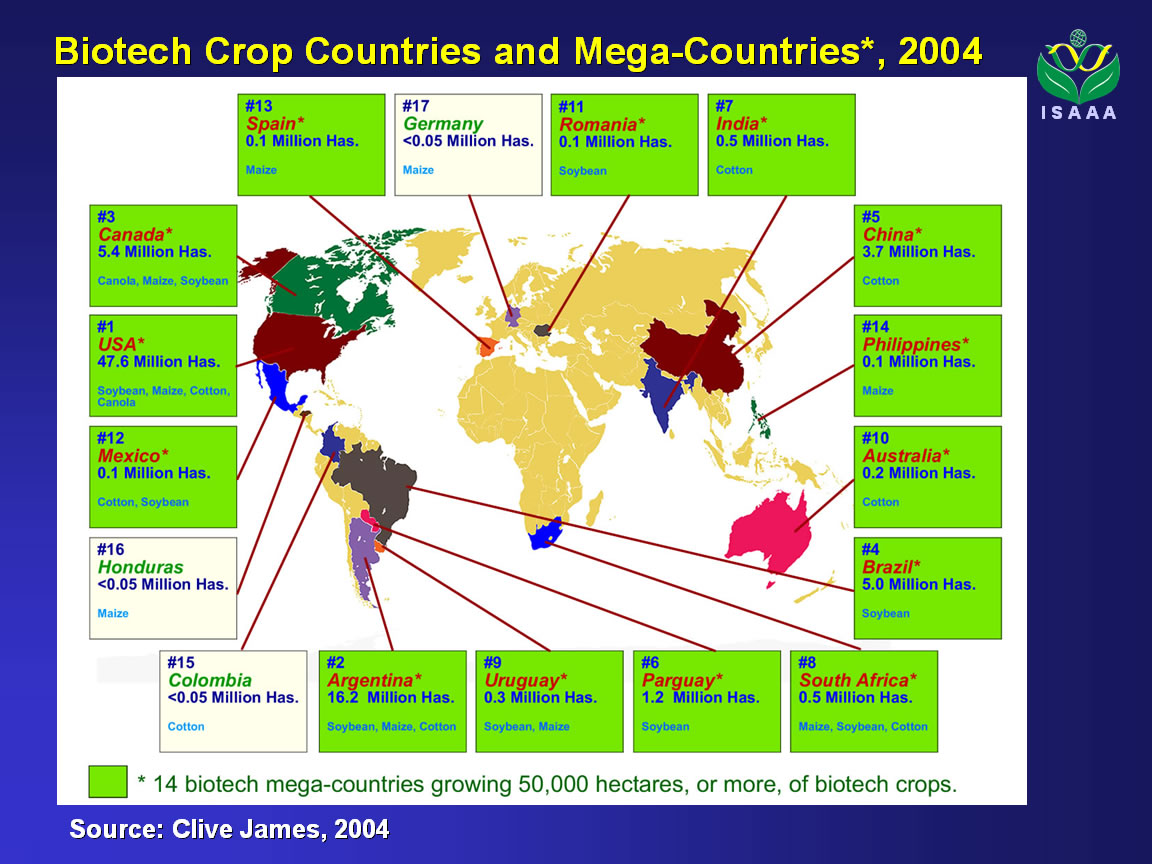
The report by the International Service for the Acquisition of Agri-biotech Applications (ISAAA) said the global area for GM crops grew to 200 million acres in 2004 from 167 million acres in 2003, an increase of 33 million acres, almost 20 percent over 2003. The technology has come a long way from 1996, when the first genetically modified crops were commercialized and only 4.3 million acres were under the genetically modified crops.
 
About 8.25 million farmers in 17 countries planted GM crops in 2004, 1.25 million more farmers than in 2003. About 90 per cent of these farmers were in developing countries.
 
Nearly all GM crops were grown in five countries - the United States, Argentina, Canada, Brazil and China. Australia grew GM cotton on about 617 thousand acres of land (250,000 hac) in 2004.
 
In India, more farmers in Andhra Pradesh, Madhya Pradesh, Maharashtra, Karnataka, Gujarat and Tamil Nadu relied on genetically modified cotton, the one biotech crop released in India.
 
ISAAA predicts up to 15 million farmers will grow GM crops on 370 million acres (150 million hectares) in up to 30 countries by the end of the decade. The biotech crop acerage in China is estimated to double in China by 2010 as the country is expected to approve genetically modified rice in 2005.
 
The Council's importers manual was revised in August 2004. The manual also contains information on the US Grains Standards.


Should you need any more information, please feel free to contact me
 
Regards
Amit Sachdev
Representative
U S Grains Council - India
E Mail: bluecross@touchtelindia.net

Saturday, January 08, 2005

Commodity Prices; Biotech Reports; More on Avian Influenza

Commodity Prices

The commodity prices is US are stable which corn and sorghum staying at the same levels as last week. Barley prices have risen by about $ 2 – 4 per ton to $ 112 – 114 per MT FOB PNW.

The price of corn co-products particularly Corn Gluten Feed has risen considerably from $ 88 per MT FOB US Gulf last week to $ 96 per MT FOB US Gulf. The price of Corn Gluten Feed (60 percent) was stable at $ 298 per MT FOB US gulf.

The corn prices in India are also stable. The average all India price (taking an average of 6 varieties traded) was Rs.5137 ($115) per MT at market yard. The highest was for Local variety (Rs.5500 - $ 124 per MT), while the lowest was for Hybrid/Local mixed (Rs.4550 - $ 102 per MT).

In the states, the prices are stable. While Local variety in Andhra Pradesh was sold at Rs.5000 ($110) per MT, the same was sold at Rs.4920 ($110) per MT in Karnataka. The Yellow variety traded at Rs.6150 ($ 138) per Mt in Gujarat markets.

While the arrivals of corn are still ranging at about 100 – 120 MT per day at some of the market yards in Andhra and Karnataka, the arrivals are trickling in other markets.

The rabi sowing is almost complete. Last reports suggest the corn sowing to be marginally higher than last year (0.57 mill hac from 0.55 mill hac). The wheat on the other hand has shown a major decline from last years 204 mill hac to 186 mill hac. The only major rise in planting is being seen in oil seeds.

Biotech Reports from IFPRI and CIFAP

Poorer nations turn to publicly developed GM crops – IFPRI Report (from Seed Quest)
Joel I. Cohen, Nature Biotechnology, Volume 23, No. 1, January 2005, pp. 27-33.

In developing countries, public institutions are conducting groundbreaking research to produce genetically modified (GM) crops, according to an article published in Nature Biotechnology.

The article highlights the results of a new IFPRI study on the development of genetically modified crops by research institutes in 15 developing countries. The first of its kind, this study assesses the state of biotech crop research, the types of genes being used, and the biosafety and regulatory challenges poor countries face. The complete report in PDF format (462K) can be found at:
http://www.ifpri.org/pubs/articles/2005/naturebiotech.pdf

"Our study debunks many misconceptions about biotech crop research," said Joel Cohen, IFPRI Senior Research Fellow and author of the article. "Many people assume that large multinational corporations control the global development of genetically modified foods, but the reality is that poor countries have vibrant programs of public biotech research. Often this research draws upon indigenous plant varieties to cultivate improved crops for local use by small-scale farmers."

According to the study, current biotech research has the potential to reduce the use of pesticides. In the future, biotech crops may increase drought tolerance and resistance to saline soils and improve the nutritional value of staple foods.

The study documents biotech research on 45 different crops, including cotton, corn, cacao, and cassava. The majority of this research focuses on improving resistance to diseases and pests which can devastate yields for farmers in poor countries. However, most of the research is currently being developed in laboratory, greenhouse, or confined field trials. Very little is currently available for use by farmers.

"Unfortunately, most poor countries lack the knowledge, capacity, and funding to develop and comply with biosafety regulatory requirements. As a result, GM crops face difficulties moving from the lab to farmers' fields," noted Patricia Zambrano of IFPRI, who contributed to the study.

While previous reports have examined biotech crop research in developing countries, this study is the first to draw the connection between regulation and specific crops and genetic traits, showing the policy implications of the research. This information will be critical to policymakers for improving biosafety regulation.

"Poor countries are often unwilling or unable to test commercial GM crops because of national policies or regulatory systems that are not prepared to grant approval for general use," Cohen explained. "Researchers in industrialized and developing countries need to work together to provide science-based information for decision makers, so that they can enhance the clarity of regulatory policies and procedures."

The study recommends an increase in small-scale, confined field trials to test crops and receive feedback from farmers. It also stresses the need for improved information sharing among developing countries.

"The information in this study will assist developing countries to strengthen the effectiveness of research and regulation, so that they can maximize benefits to small-scale farmers," said Mark Rosegrant, director of Environment and Production Technology at IFPRI.

Value of Biotech Crops and its growth – CIFAP report

Another report by University of Minnesota’s Centre for International Food and Agriculture Policy has put the value of GM crops grown around the world at $44 billion. The report also states that 98 percent of the value is coming from just 5 countries: Argentina, Brazil, Canada, China and US. Within the next decade the value of biotech crops is estimated to grow to $210 billion and adoption of these technologies will increase the GDP of these countries by almost 2 percent.

Of the total value US leads the way with $27.7 billion, largely from soybeans, maize, cotton and canola followed by Argentina with US$8.9 billion (soybeans and corn); then China with US$3.9 billion (cotton); Canada, US$2 billion (canola, corn and soybeans); and Brazil, US$1.6 billion (soybeans). The United States also is the largest biotech producer, planting 42.8 million hectares (105.8 million acres) in 2003/04.

Biotech crops are grown in 18 countries and another 45 countries are engaged in research and development work. Of these total 63 countries more than half are developing countries.

"Western Europe, China, Argentina, Brazil, South Africa, Australia and India are centres of influence that will help lead development into the future," the study finds.

For example, China's government has invested several hundred million dollars in the new technology, ranking it second in the world in GM research funding behind the US.

Half of China's farm fields may be growing genetically modified crops in 10 years, as Beijing invests hundreds of millions of dollars in the new technology. China increased its biotech cotton production for the fifth straight year in 2003/04, planting 2.8 million hectares (6.9 million acres) or about 68 percent of its annual cotton crop.

China is developing and testing a wide variety of gene-altered crops, such as corn, soybeans, rice, potatoes and tomatoes. A pioneer in developing biotech rice, Beijing could release its first variety as early as next year, according to other analysts.

Biotech crops typically have a special gene inserted to help a growing plant fight destructive insects, or to tolerate an herbicide used to kill a broad variety of weeds.

Critics, especially in Europe, say biotech crops pose too many risks to the environment and to human health.

The 121-page global biotech outlook report was funded by the Council for Biotechnology Information, which promotes the use of biotechnology.

More on Avian Influenza

Avian Influenza is showing its fangs again. With the death of a Vietnamese boy last week the toll has gone up to 22 in Vietnam. This was the second death in the week. Bird flu has been reported in 11 provinces of Vietnam’s Mekong Delta. Around 28,000 birds have been culled since Dec 2004. The spread of the virus is linked to cold and humid weather.

More information about Avian Influenza and its implication of Human diseases can be found at:
http://www.cidrap.umn.edu/cidrap/content/influenza/avianflu/biofacts/avflu_human.html

Please let us know your comments

Regards
Amit Sachdev
Representative
U S Grains Council - India